
Play
Dog Play Bow Meaning
The play bow is famous, but it does not always mean 'let's play.' Here is the contrarian truth about this commonly misread signal.
The 'Play Means Play' Myth
Open any beginner dog training book and they will all tell you the exact same lie about the play bow. They show you a cartoon of a dog with its butt in the air and its front elbows on the ground, captioned: 'This is the universal canine invitation to play.' This is dangerously incomplete. Not every play bow is an invitation to play. Some are predatory setups. Some are apologies. Some are pure displaced stress. I take on around ten new dogs a month, and most of the dog park bite incidents I get called in to consult on started with a play bow that was not actually playful. If you cannot read the difference between a real play bow and a fake one, you are eventually going to walk your dog straight into a fight you didn't see coming.
The Loose Bow vs The Stiff Bow
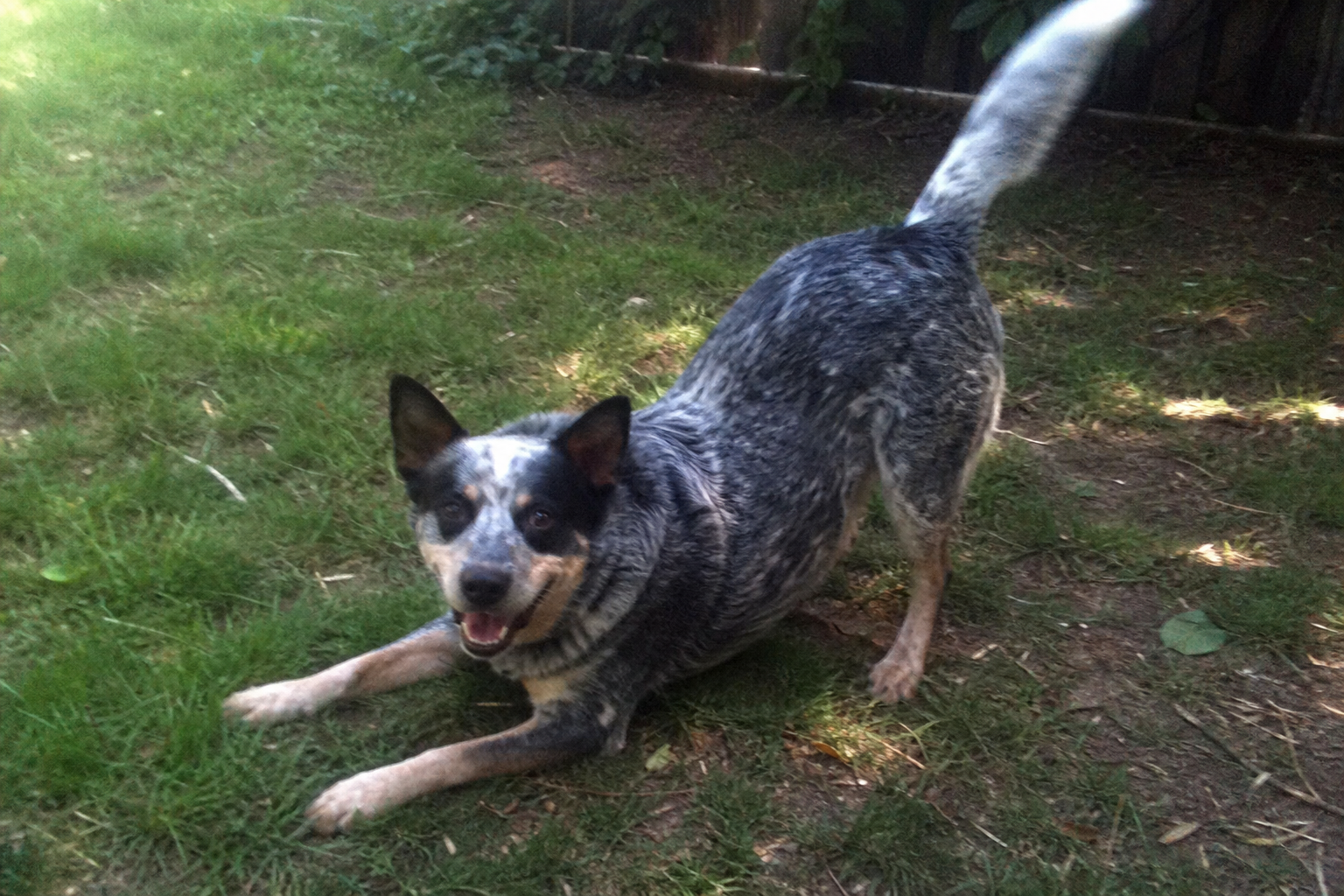
A real play bow has loose muscles. Watch the back. The spine should curve like a hammock, the tail should be wagging in a sweeping motion, the mouth should be open and relaxed, and the ears should be neutral or slightly back. The dog will often bounce in and out of the bow several times in a row to clearly communicate playful intent. The whole thing looks bouncy, like a spring. A stiff bow is a completely different animal. The spine is locked. The tail is held high and rigid, sometimes vibrating at the very tip. The mouth is closed. The eyes are hard and locked onto the other dog. This is not an invitation to play. This is a predatory crouch, almost identical to the body language a wolf uses before it pounces on prey. If you see a stiff bow, get your dog out of there.
Get dog advice that actually works.
The Apology Bow
Sometimes a play bow is an apology. Dogs who play hard, especially during tug or wrestling, can occasionally cross a line. They bite too hard, they body-slam too rough, or they steal a toy too aggressively. When the other dog yelps or stiffens, a well-socialized dog will often immediately drop into a quick bow as a peace offering to keep the game going. Mudflap, an Australian Cattle Dog I walk on Fridays, does this constantly. Mudflap's owner runs a hot sauce subscription box business out of his garage and insists that Mudflap can identify which sauces are made with ghost peppers just by smell. Anyway, Mudflap is a rough player. He bites a little too hard during wrestling, and the moment the other dog complains, he immediately drops into a bow that says, 'My bad, please don't quit on me, let's keep playing.' That kind of social repair is the sign of a well-adjusted dog.
The Predatory Stalk
The predatory bow is the one that gets dogs in trouble. High-drive working breeds — Cattle Dogs, Border Collies, Belgian Malinois, certain terriers — will sometimes drop into a play-bow-shaped crouch right before they chase another dog, a kid on a bike, or a squirrel. Their genetics are telling them to herd or hunt, and the body shape happens to look identical to a play bow to an untrained eye. The difference is in the eyes and the freeze. A real play bow lasts about half a second before the dog bounces back up to play. A predatory crouch holds. The dog will freeze in that low position, locked on, for several seconds before exploding forward. If you see a stiff, frozen 'play bow' that does not bounce up within a second, you are watching a stalk, not an invitation.
Stop Letting Them 'Work It Out'
Dog park culture has this exhausting habit of telling owners to 'let the dogs work it out.' That advice is the reason emergency vets are full of dog bite cases every weekend. Dogs do not always work it out. Sometimes one dog is being a jerk, and the other dog has no good options, so they snap. Your job as the owner is to read the bows. Loose bows that bounce are play. Stiff bows that freeze are not. If you see your dog or another dog drop into a freeze that does not unfreeze within a second, walk in calmly, recall your dog, and end the interaction. Better to be the buzzkill at the dog park than the person standing at the emergency vet at 9 PM on a Sunday with a $4,000 bill.

Written by
Sammie LaFleur
Professional Dog Walker
Sammie LaFleur is a professional dog walker. She owns three dogs, walks five regular client dogs a day, five days a week, and takes on at least ten new dogs every month. She is an avid reader who enjoys digging into dog science whitepapers. Her writing is built from street-level dog behavior and real data, not recycled pet industry talking points. Her mission is to decode canine body language so owners can stop fighting their dogs and start understanding them. For Sammie, success is measured by a single metric: increasing the number of stress-free, sunny day walks a dog gets to enjoy each year. She writes to bridge the communication gap between species, because she knows exactly what dogs want and what makes them thrive.