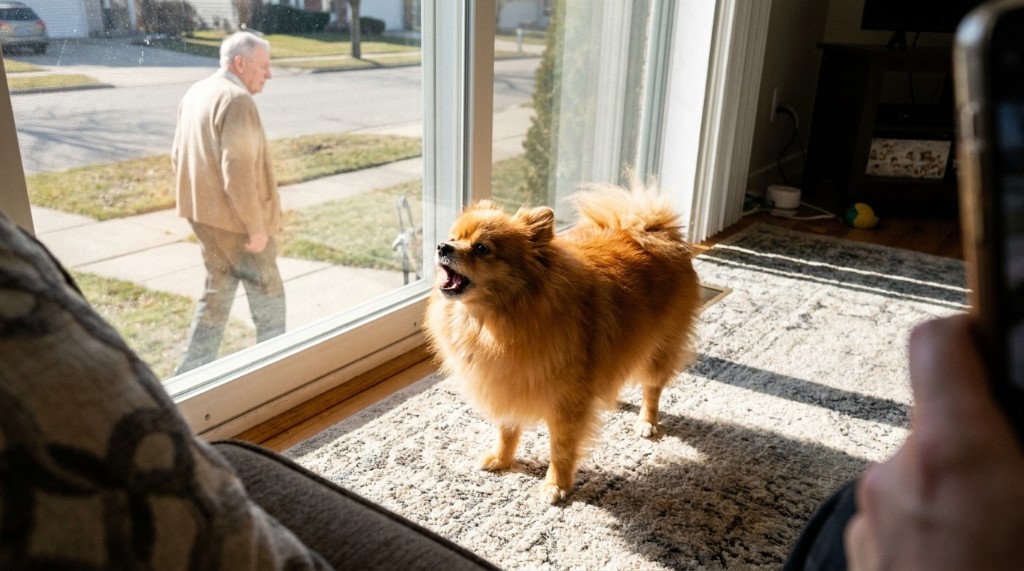
The 'Quiet' Command is a Scam: What Your Dog's Bark Actually Means
We spent 10,000 years breeding dogs to sound the alarm. Now we punish them for it. Here is how to decode the noise and actually get some peace.
Share
The 10,000-Year Misunderstanding
I take on ten new client dogs a month, and the number one complaint I hear is about barking. People treat barking like a software glitch. It's not. We literally engineered wolves over 10,000 years to sound the alarm when the camp was surrounded. Now, you live in a condo, and your dog is sounding the alarm because the Uber Eats driver is in the hallway. Yelling 'quiet' from the couch doesn't tell the dog the threat is gone; it just tells them you are stressed too. To a dog, a yelling human is just another pack member barking at the door. You aren't stopping the alarm; you are co-signing it.
Pitch vs. Pace (Decoding the Sound)
You don't need to be a dog whisperer to understand a bark; you just need to listen to the pitch and the pace. A low-pitched, slow bark (Woof... Woof...) is a warning. It means 'I see something, stay back.' A high-pitched, rapid-fire bark (Yip-yip-yip!) is excitement or panic. I walk a Schnauzer mix named Gus who has a specific, high-pitched stutter-bark only when he sees a skateboard. It's not aggression; it's pure overstimulation. If you treat Gus's skateboard bark the same way you treat a low-pitched warning bark, you will fail to calm him down. You have to match your response to the specific type of bark.
Get dog advice that actually works.
The Leash Lie (Barrier Frustration)
The most misunderstood bark happens on walks. Owners tell me their dog is 'aggressive' because they lunge and bark at other dogs. 90% of the time, it's a lie. It is actually 'Barrier Frustration.' Take Barnaby, a 70-pound Golden Retriever I walk. Off-leash at the park, he is an absolute angel. But the second you clip a 6-foot leash to his collar, he sounds like Cujo when he sees another dog. Barnaby isn't aggressive; he is frustrated. Dogs naturally greet each other in a wide arc to sniff. The leash forces them into a tense, head-on collision course. When Barnaby realizes the leash is preventing his natural greeting, he panics and barks. If you yell at a dog for barrier frustration, you are just punishing them for being trapped.
The Extortion Tactic (Demand Barking)
Then there is 'Demand Barking.' This is the sharp, repetitive bark your dog gives you when you are eating dinner or holding a tennis ball. They aren't alerting you to danger; they are extorting you. If you look at a demand barker and say 'No,' you just lost the game. You gave them eye contact and attention. To a bored dog, negative attention is still attention. The only way to beat a demand barker is absolute, stone-cold silence. Turn your back, cross your arms, and look at the ceiling. The moment they stop, the game resumes.
The 'Acknowledge and Dismiss' Method
But if your dog is alert barking at the window, ignoring them won't work. You have to relieve them of duty. You have to get up, walk to the window, physically look at what they are barking at, and say in a calm voice, 'Okay, I see it. Thank you.' Then walk away. You are the pack leader acknowledging the threat and dismissing the guard. You are telling them, 'I have assessed the situation, and I am taking over security.' Once I started doing this with my client dogs, nuisance window barking dropped by 80%. Stop fighting their genetics and start acknowledging their work.
The Boredom Bark (Separation vs. Under-stimulation)
Finally, we have to talk about the 'Boredom Bark.' Many owners set up a $200 pet camera, see their dog barking for an hour after they leave for work, and immediately diagnose them with severe separation anxiety. Usually, the dog isn't having a panic attack; they are just incredibly bored. I had a client with a Husky mix named Luna who barked non-stop from 9 AM to noon. The owner thought Luna missed her. I told the owner to freeze Luna's breakfast inside a puzzle toy instead of feeding her from a bowl. The barking stopped entirely. Luna didn't have separation anxiety; she was just an unemployed working breed looking for a job.
Before you assume your dog is traumatized by your absence, make sure you aren't just leaving them with nothing to do. If I have a client who is convinced their dog has separation anxiety, I make them log the actual pitch and frequency of the barking. Usually, the data proves the dog isn't panicking—they are just complaining to the management.
Liked it? Share it.
A quick note from the team: If you are dealing with a dog that won't listen to human commands, we built a tool that might help. The Dog Wave AI app (available on Android) plays 20 scientifically proven, actual recorded dog vocalizations to act as a pattern interrupt.
Written by
Sammie LaFleur
Professional Dog Walker
Sammie LaFleur is a professional dog walker. She owns three dogs, walks five regular client dogs a day, five days a week, and takes on at least ten new dogs every month. She is an avid reader who enjoys digging into dog science whitepapers. Her writing is built from street-level dog behavior and real data, not recycled pet industry talking points. Her mission is to decode canine body language so owners can stop fighting their dogs and start understanding them. For Sammie, success is measured by a single metric: increasing the number of stress-free, sunny day walks a dog gets to enjoy each year. She writes to bridge the communication gap between species, because she knows exactly what dogs want and what makes them thrive.
Free updates, no spam
Stay in the pack.
Get notified when new dog guides drop, free games go live, and the Dog Wave app gets new features.