
Body Language
Dog Hackles Raised: What It Really Means
Raised hackles do not mean your dog is aggressive. That is one of the most damaging myths the pet industry has ever invented.
The 'Aggressive Dog' Lie
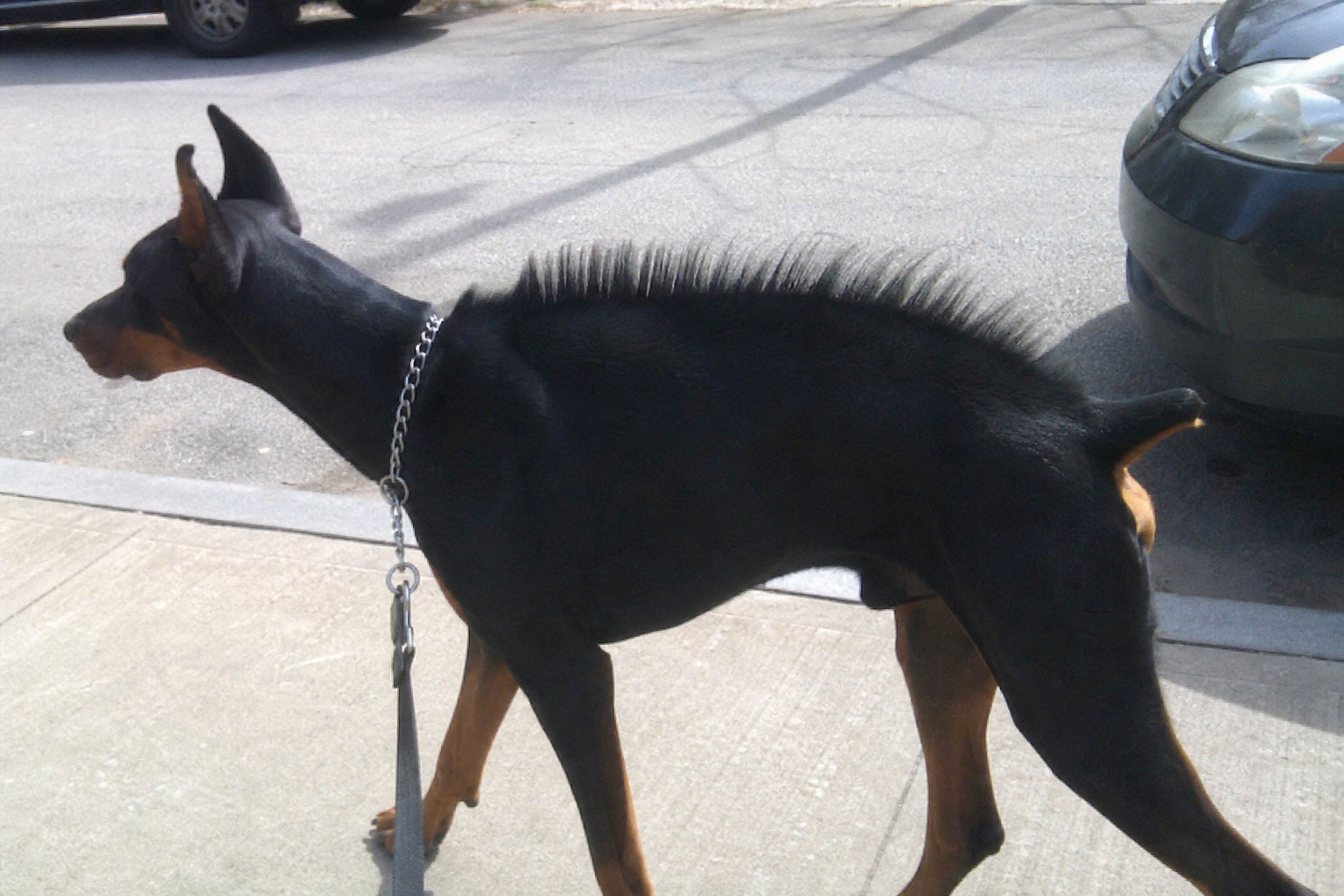
Walk into any dog park in America with a dog who has raised hackles, and within thirty seconds, some random bystander will be screaming at you to leash your 'aggressive' animal. This is one of the most damaging myths the corporate pet industry has ever invented. Raised hackles do not mean a dog is aggressive. They mean the dog is emotionally aroused, which is a completely different thing. I evaluate ten new dogs a month, and at least three of them come to me with the label 'aggressive' stamped on their file because some uninformed stranger saw the hair stand up on their back. Take Velvet, a 75-pound Doberman I walk on Tuesdays. Velvet's owner is a woman who exclusively communicates in voice memos that are always exactly seven minutes long, regardless of what she is saying. She was about to surrender Velvet to a shelter because three different people at the dog park told her the dog was 'going to maul someone' based on hackle display alone. Velvet has never bitten a single living creature. She is just a deeply expressive dog with a sensitive nervous system.
It's Just Piloerection
Hackles are not a controlled behavior. The clinical term is 'piloerection,' and it is the exact same biological reflex that gives humans goosebumps when they hear a great chord progression or step into a cold room. The arrector pili muscles at the base of the hair follicles contract involuntarily, pulling the hair upright. Dogs cannot decide to raise their hackles any more than you can decide to grow taller. It is a pure autonomic nervous system response to stimulation. This means a dog can raise their hackles when they are scared. They can raise them when they are excited. They can raise them when they smell something particularly interesting. They can even raise them while playing tug. If you assume every raised hackle is a sign of impending violence, you are going to spend your entire life misreading dogs and ruining their social lives.
Get dog advice that actually works.
Where the Hair Stands Matters
Now, where the hackles raise on the body actually tells you something useful. This is the part the cartoon body language charts always leave out. If the hackles raise only at the shoulders, in a small patch at the base of the neck, you are usually looking at a confident, forward-driven response. The dog has noticed something and is investigating it with confidence. If the hackles raise in a full strip down the entire spine, all the way to the base of the tail, you are looking at a much higher level of arousal. This is the response to a major stimulus. And if the hackles raise specifically at the rear, near the tail, you are often looking at a fear-based response. A dog with raised rear hackles usually feels they have something to defend, and they don't feel confident about it.
The Confidence Hackle
Velvet has massive shoulder hackles every time she sees her best dog friend, a Newfoundland named Truck, across the street. Her owner was convinced she was about to attack him. She wasn't. Her tail was wagging in a loose helicopter sweep, her face was soft, her mouth was relaxed and open, and her body was completely fluid. The hackles were just pure excitement, nothing more. The hair on her back was her nervous system saying 'oh boy oh boy oh boy.' Hackles without the accompanying body tension are essentially meaningless. If you label a dog aggressive based on hackles alone, you are going to ruin perfectly good dogs by treating them like ticking time bombs and watching them slowly become the anxious, defensive animals you assumed they were.
Reading the Whole Body
You cannot read hackles in isolation. Hackles are one data point in a system of about a dozen body language signals that you have to read together. Is the tail high and stiff, or loose and sweeping? Is the spine rigid or fluid? Are the ears pinned, forward, or relaxed? Is the weight forward over the front paws, or balanced over all four? Is the mouth open and panting, or closed and tight? A dog with raised hackles, a high stiff tail, forward weight, pinned-forward ears, and a closed tense mouth is a problem. A dog with raised hackles and any of those other indicators relaxed is just a dog reacting to life. Stop labeling dogs based on the hair on their back. Look at the whole animal.

Written by
Sammie LaFleur
Professional Dog Walker
Sammie LaFleur is a professional dog walker. She owns three dogs, walks five regular client dogs a day, five days a week, and takes on at least ten new dogs every month. She is an avid reader who enjoys digging into dog science whitepapers. Her writing is built from street-level dog behavior and real data, not recycled pet industry talking points. Her mission is to decode canine body language so owners can stop fighting their dogs and start understanding them. For Sammie, success is measured by a single metric: increasing the number of stress-free, sunny day walks a dog gets to enjoy each year. She writes to bridge the communication gap between species, because she knows exactly what dogs want and what makes them thrive.