
Daily Life
What Your Dog's Sleeping Position Actually Means
Spare me the BuzzFeed personality quizzes. Here is the contrarian truth about why your dog sleeps the way they sleep.
The Personality Quiz Lie
Every two months a new viral article makes the rounds claiming that your dog's sleeping position reveals their hidden personality. "The Donut means they're independent! The Superman means they're playful! The Side Sleeper means they're confident!" This is the canine equivalent of a tabloid horoscope. There is zero peer-reviewed evidence linking sleeping position to personality. Zero. The articles get clicks because they are fun, not because they are true. Your dog's sleeping position is overwhelmingly driven by three boring physical variables: temperature, surface, and how safe they feel in that exact moment. Once you understand those three things, you stop reading personality into a sleeping position and you start reading something actually useful — your dog's physical comfort and emotional state.
Sleep Position is About Temperature
The single biggest driver of sleep position is body temperature regulation. Dogs cannot sweat to cool down. They can only pant and find cooler surfaces. So when they are hot, they spread out — bellies on tile, legs splayed, "sploot" position, full sideways stretch. The goal is maximum surface area in contact with cool ground. When they are cold, they curl. The classic "donut" position with the nose tucked to the tail minimizes surface area and traps body heat against the core. Long-coated breeds in the summer will sploot. Short-coated breeds in the winter will donut. Same dog, opposite postures, completely temperature-driven. None of this has anything to do with their personality.
Get dog advice that actually works.
The Curled Donut
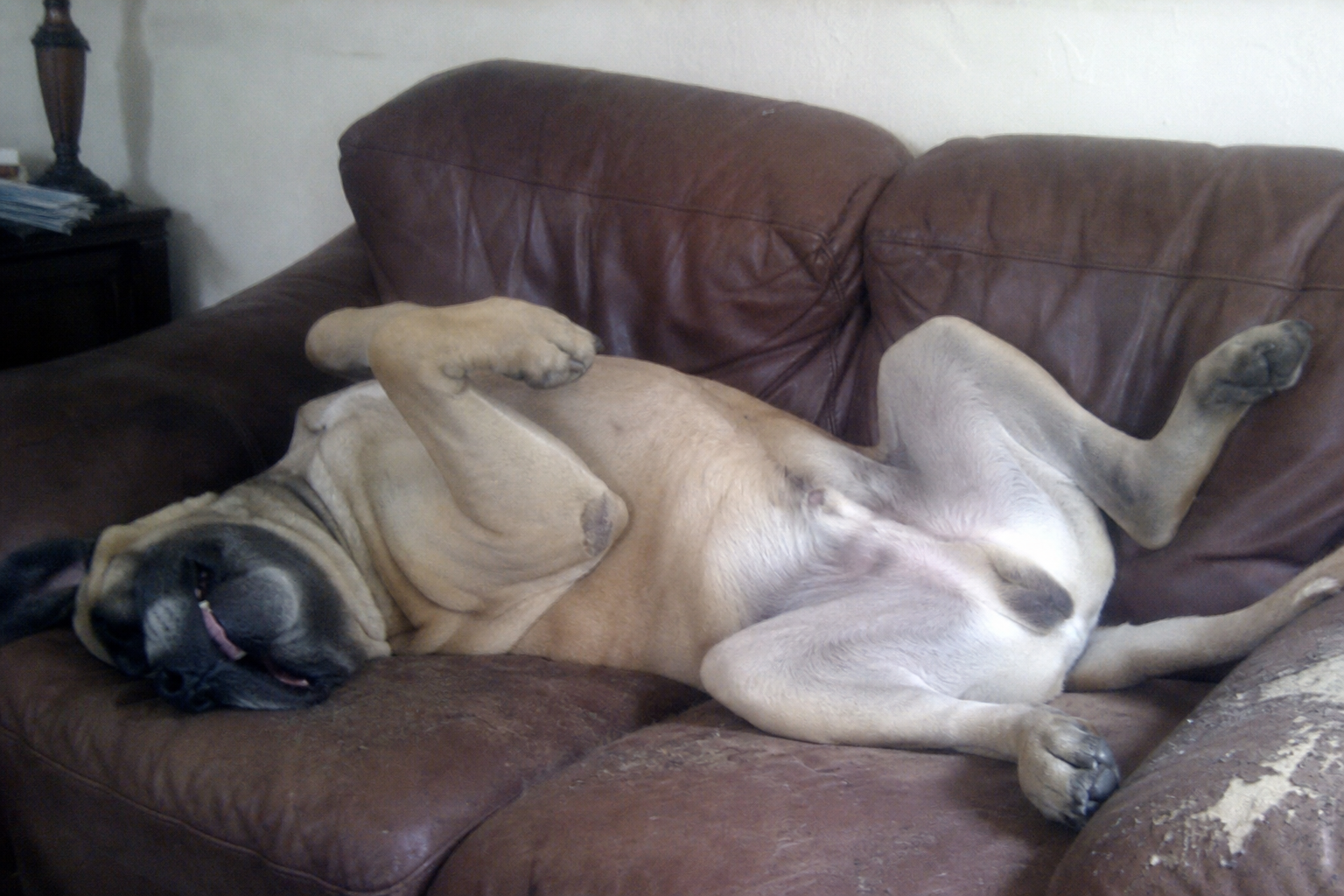
The donut sleep is the most ancestral, most protective sleeping position. The spine is curved, the vulnerable belly is hidden, the head is tucked, and the dog can spring up quickly from this position if needed. Wild canids almost always sleep curled like this when sleeping in the open. Domestic dogs default to it when they feel even slightly unsure of their environment. I walk a 200-pound English Mastiff named Couch on Wednesdays. Couch's owner is a guy who has named his sourdough starter "Brenda" and brings her up in every single conversation — he will be talking about the weather and somehow get back to how Brenda is doing this week. Couch sleeps in a tight donut every single time he is at the dog park or at a new house, even though he weighs as much as a small adult human. He does not feel safe enough in those environments to fully sprawl. At home on the couch, he sleeps belly up. Same dog. Different environments. Completely different postures.
The Belly-Up Sploot
The belly-up position, with all four legs in the air, is the position dogs choose when they feel completely safe and they are warm. The belly is the most vulnerable part of a dog's body — it is unarmored, full of major organs, and exposes the throat. A dog who sleeps belly-up in your living room is telling you something real about their emotional environment. They have no expectation that anything bad will happen to them while they are unconscious. This is one of the few sleep position signals that actually means something useful. A dog who never sleeps belly-up around you is a dog who is not yet fully relaxed in your home, even if they seem friendly when awake. A dog who flops onto their back and snores in front of you has done the math and decided you are safe.
What Actually Tells You About Sleep Health
Stop reading personality quizzes about sleep position and start watching your dog's actual sleep quality. Are they getting roughly 12 to 14 hours of sleep a day for an adult dog, more for puppies and seniors? Are they cycling through REM phases, indicated by occasional paw twitches and soft vocalizations? Are they waking up easily and stretching when they get up? Are they restless at night, pacing, panting, or repositioning constantly? A restless, frequently-repositioning dog is the actual red flag. Pain, arthritis, GI issues, and anxiety all show up in disrupted sleep long before they show up in obvious daytime behavior. Watch the sleep quality, not the sleep position. The position is mostly weather. The quality is medicine.

Written by
Sammie LaFleur
Professional Dog Walker
Sammie LaFleur is a professional dog walker. She owns three dogs, walks five regular client dogs a day, five days a week, and takes on at least ten new dogs every month. She is an avid reader who enjoys digging into dog science whitepapers. Her writing is built from street-level dog behavior and real data, not recycled pet industry talking points. Her mission is to decode canine body language so owners can stop fighting their dogs and start understanding them. For Sammie, success is measured by a single metric: increasing the number of stress-free, sunny day walks a dog gets to enjoy each year. She writes to bridge the communication gap between species, because she knows exactly what dogs want and what makes them thrive.