
Behavior
Why Dogs Jump On People (And How To Actually Stop It)
If your trainer told you to knee your dog in the chest, find a new trainer. Here is the contrarian truth about jumping.
The "Knee Them" Garbage
The first page of Google for "how to stop dog jumping" still contains advice from the 1970s. Knee them in the chest. Step on their toes. Yell. Squirt them with water. Pinch their paws. This advice is somehow still being republished by major pet sites in this current decade. It is abusive, it does not work long-term, and it teaches your dog to associate human bodies with pain. We have known this since the 1990s and the bad advice is still everywhere. Punishing jumping does not extinguish jumping. It teaches your dog to be afraid of certain people, certain hands, or certain situations, while leaving the underlying motivation completely intact. Then the moment the punishment is not present, the jumping comes right back, often worse. You cannot punish your way out of an emotional behavior.
Jumping is a Face-Greeting
Dogs greet each other face to face. It is hardwired. They sniff faces, lick muzzles, exchange information through the eyes and nose. The problem is that human faces are five to six feet off the ground. To a dog, the only way to do a proper greeting with a human is to get up to face height, and the only way to get up to face height is to jump. The jumping dog is not being dominant, rude, or disrespectful. The jumping dog is trying to greet you the way they greet every other social being in the world. We bred them for tens of thousands of years to want to be close to us. Then we built them in a body that is too short to reach our faces. The conflict is on us, not them.
Get dog advice that actually works.
Every Owner Trains This Accidentally
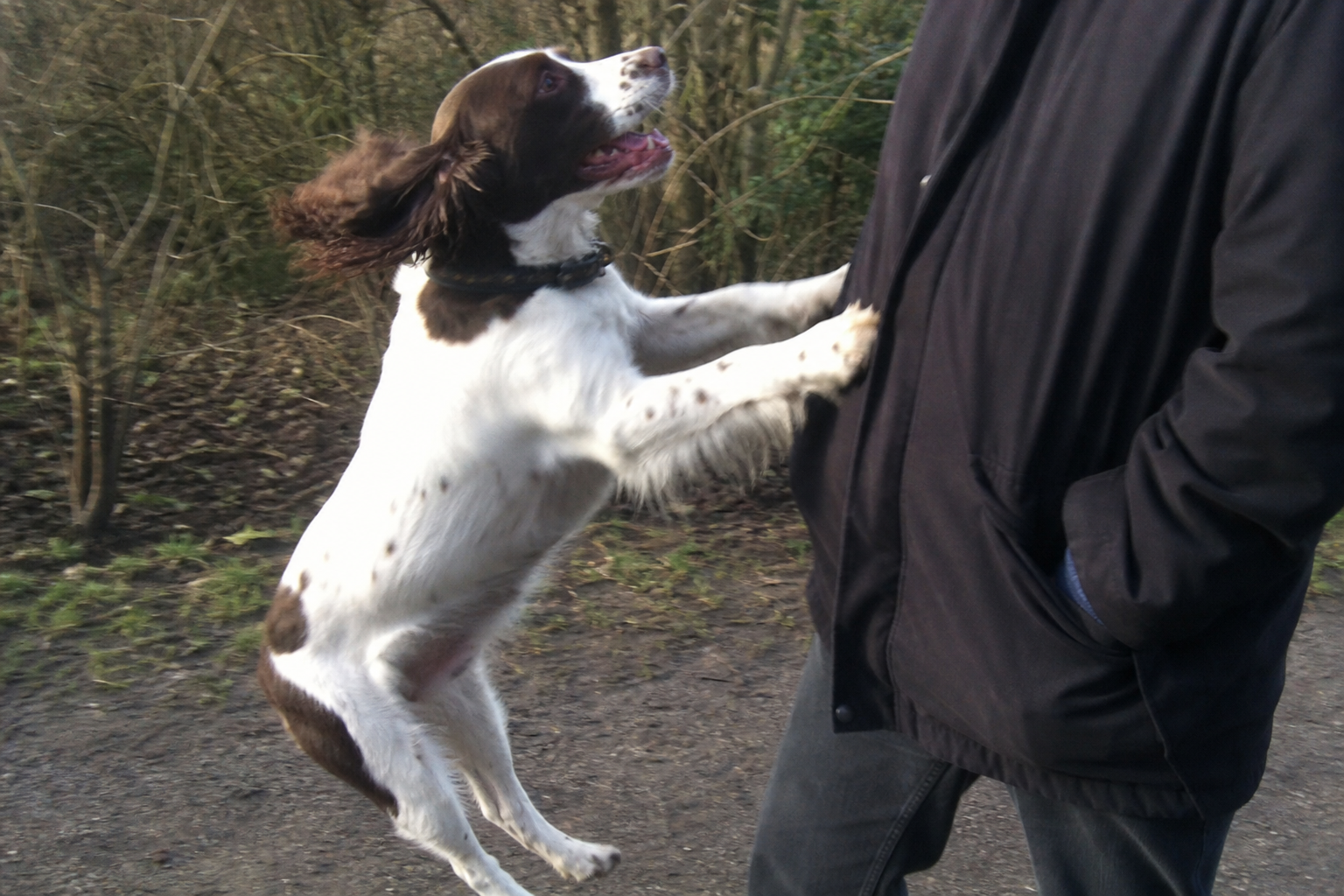
Here is the part nobody wants to admit. Almost every jumping problem is created by the owner accidentally training it. Puppy jumps up because they are excited. Owner scoops them up and cuddles them. Puppy learns: jumping makes the human pick me up. Repeat 200 times during puppyhood. By the time the dog is 65 pounds, the behavior is rock solid, and now the owner is angry about it. I walk an English Springer Spaniel named Volume on Tuesdays. Volume's owner runs a tiny business making custom Halloween costumes for backyard squirrels — yes, she sews miniature pirate outfits for the squirrels in her yard, and she has been featured in two local newspapers for it. When Volume was a puppy, she let him jump on her every single day for two solid years. He is now four years old and a fully trained jumping machine. He did not invent that behavior. She built it, one cuddle at a time.
The Four-on-the-Floor Protocol
The actual fix is unsexy and requires consistency from every human the dog interacts with. The rule is simple: attention only happens when all four paws are on the floor. Dog jumps up to greet you, you turn your back, fold your arms, and look at the ceiling. The moment the paws touch the floor, you turn around, crouch down low to greet the dog at their level, and pet them. Repeat thirty times a day for two weeks. What you are teaching is the opposite of what jumping has always paid out. Jumping now produces nothing. Standing produces full greeting. You are also crouching, which removes the height problem entirely — the dog does not need to jump because your face has come down to greet them. The crouch is the missing half of the protocol that most trainers skip.
Stop Punishing Excitement
The dog is jumping because they love you and they want to greet you. That is not a problem to be punished. That is a problem to be redirected. Punishing a dog for being excited to see you is one of the most short-sighted things you can do in your relationship with your dog. You are signaling that being happy to see you is dangerous. If every adult in your house and every regular visitor follows the four-on-the-floor rule for two solid weeks, the jumping will fade. If half the people in your dog's life follow it and the other half keep cuddling the dog when they jump, you will be fighting this behavior forever. Consistency is the entire intervention. The dog is not the problem. The mixed signals are the problem.

Written by
Sammie LaFleur
Professional Dog Walker
Sammie LaFleur is a professional dog walker. She owns three dogs, walks five regular client dogs a day, five days a week, and takes on at least ten new dogs every month. She is an avid reader who enjoys digging into dog science whitepapers. Her writing is built from street-level dog behavior and real data, not recycled pet industry talking points. Her mission is to decode canine body language so owners can stop fighting their dogs and start understanding them. For Sammie, success is measured by a single metric: increasing the number of stress-free, sunny day walks a dog gets to enjoy each year. She writes to bridge the communication gap between species, because she knows exactly what dogs want and what makes them thrive.