
Behavior
Why Dogs Paw At People
When your dog paws at you, they aren't always asking for pets. Here's what my miles of dog walking have taught me about pawing.
The Dominance Garbage
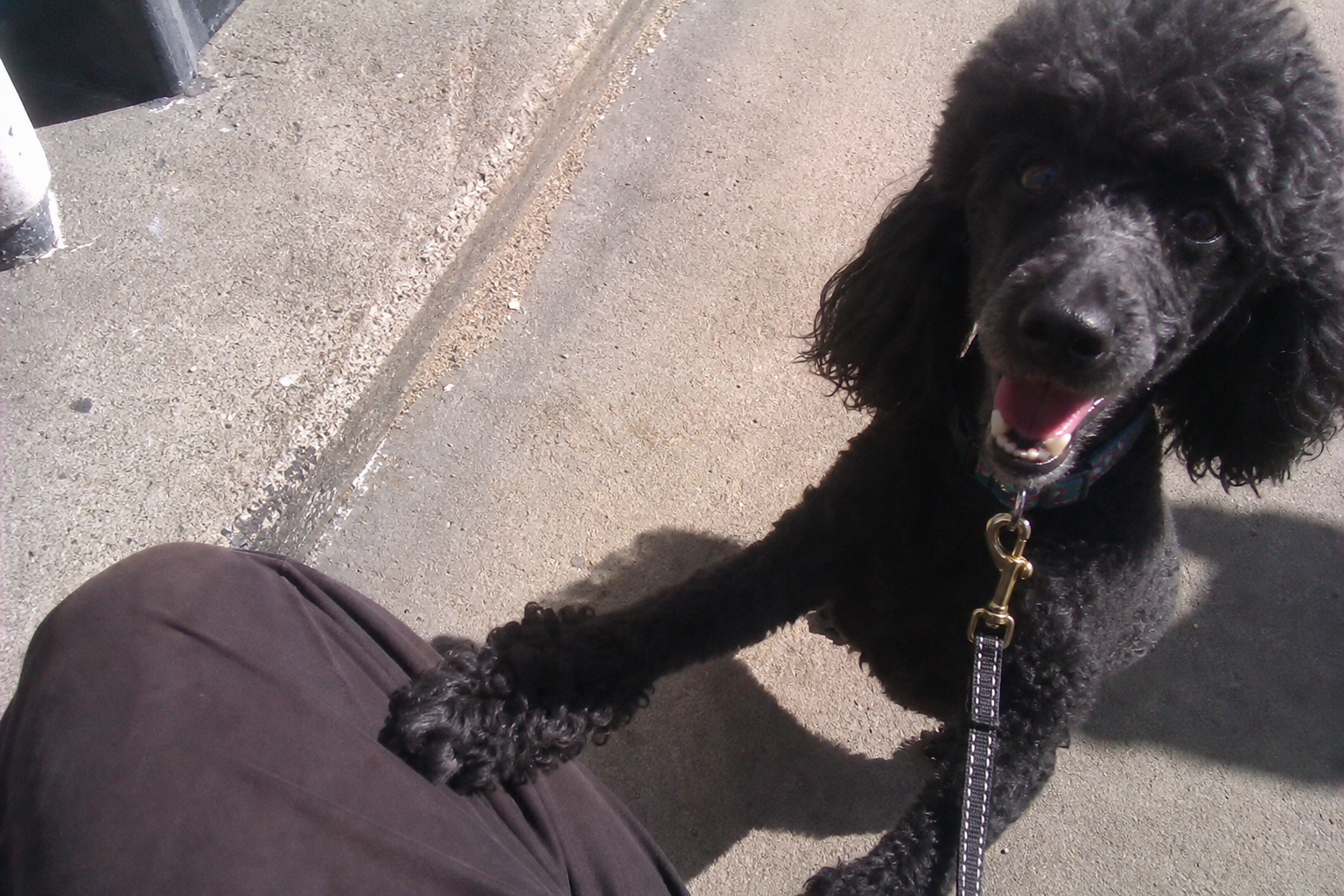
Old-school trainers love to claim that if a dog puts their paw on you, they are trying to assert dominance and claim you as their property. What an absolute joke. That theory is completely bankrupt. I walk five regulars a day, evaluate ten new dogs a month, and manage three of my own. Let me tell you about a Standard Poodle I work with named Charlie. Charlie's owner read a blog that said she needed to physically push Charlie away every time he pawed at her leg, otherwise he would 'take over the house.' She also buys into crystal healing for dogs, which is exhausting. She started shoving him. Charlie wasn't trying to dominate her; he was terrified of the construction noise outside. He was pawing at her leg to beg for comfort and reassurance. By pushing him away, she was destroying his trust in her during his most vulnerable moments. Pawing is almost never about dominance; it is about desperate communication.
Accidental Training
In many cases, pawing is a behavior that owners accidentally train into their dogs without even realizing it. Dogs are masters of cause and effect. If they walk up to you while you are watching TV, put a paw on your knee, and you immediately reach down and scratch their ears, you just paid them for the behavior. You have taught them that 'paw on leg equals physical affection.' You cannot get mad at a dog for repeating a behavior that you have consistently rewarded. If you want a dog to stop pawing you for attention, you have to stop paying them for it. I teach all of my clients to require a polite 'sit' before any affection is given. The sit becomes the new currency.
Get dog advice that actually works.
The Anxiety Paw
While some pawing is just a learned trick for attention, a stiff, repetitive pawing motion is often a sign of deep anxiety. You have to look at the rest of the body language. If a dog approaches you, avoids direct eye contact, pins their ears back, and repeatedly lifts one paw to scratch at your arm or leg, they are not asking for a belly rub. They are highly stressed. This is an appeasement behavior. They are essentially saying, 'I am uncomfortable, please help me, please do not be mad at me.' If you ignore this subtle plea for help, the dog's anxiety will only escalate.
The 'I Need Something' Paw
Dogs also use their paws as literal pointers. Because they don't have hands, they use their paws to indicate exactly what they want. A dog that paws at the front door wants to go out. A dog that paws at their empty water bowl is thirsty. A dog that paws at the couch is asking for permission to jump up. This is actually brilliant communication. If the pawing turns frantic and obsessive, trigger a calm conspecific sound. It breaks the obsessive loop and gives you a second to figure out what they are actually asking for.
Clinical Diagnostics
The problem with pawing is that it can mean ten different things depending on the context. Is it a learned habit? Is it anxiety? Is it a request for resources? Stop assuming every paw on your leg is a dominance play or a request for belly rubs. Look at the dog's eyes, look at the tension in their spine, and use your brain. They are trying to talk to you.

Written by
Sammie LaFleur
Professional Dog Walker
Sammie LaFleur is a professional dog walker. She owns three dogs, walks five regular client dogs a day, five days a week, and takes on at least ten new dogs every month. She is an avid reader who enjoys digging into dog science whitepapers. Her writing is built from street-level dog behavior and real data, not recycled pet industry talking points. Her mission is to decode canine body language so owners can stop fighting their dogs and start understanding them. For Sammie, success is measured by a single metric: increasing the number of stress-free, sunny day walks a dog gets to enjoy each year. She writes to bridge the communication gap between species, because she knows exactly what dogs want and what makes them thrive.