
Behavior
Why Dogs Hump
The "dominance" explanation is decades of debunked junk science. Here is what is actually going on when your dog mounts a couch cushion in front of your dinner guests.
The "Dominance" Garbage
The whole "dominance" framework around humping comes from a single 1940s study of unrelated captive wolves in a zoo enclosure, and the scientist who wrote that study has spent the last twenty years publicly begging the pet industry to stop quoting him. The dominance theory of dog behavior is dead. It was killed by actual researchers studying actual wolves in actual wild populations, and yet it lives on in every cheap dog training listicle on the internet, particularly when it comes to humping. Your dog is not humping to "establish dominance" over the couch cushion, the toddler, the guest dog, or the stuffed pig. That framework explains nothing and predicts nothing. It is a relic of bad mid-century animal behavior research, and anyone still using it to explain your dog's behavior is selling you a flawed product.
Humping is Arousal Overflow
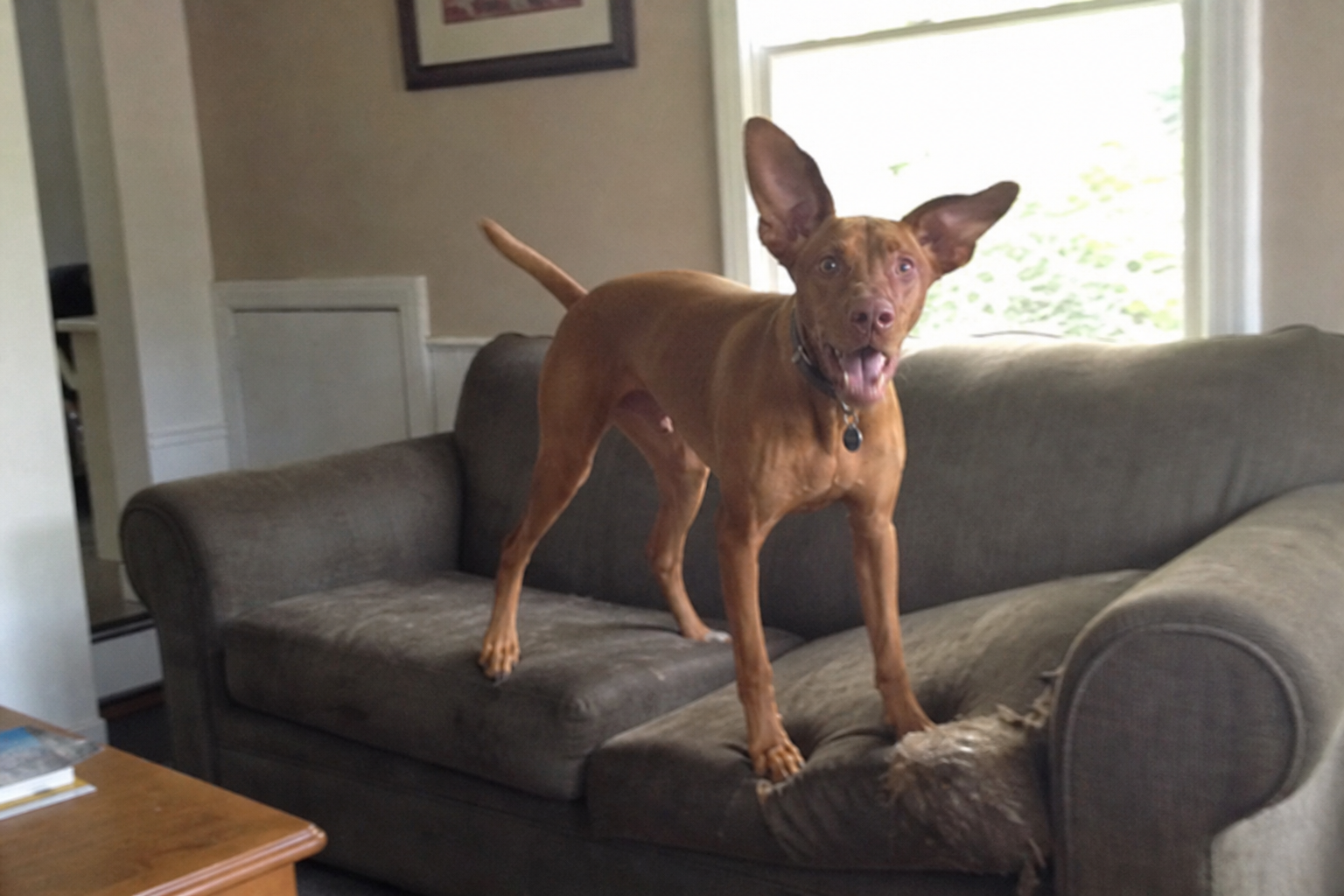
Humping is what behaviorists call a "displacement behavior" driven by general arousal. The dog's nervous system is over-stimulated, energy is pouring out, and the body falls back on a hardwired motor pattern that happens to look sexual. That is why intact dogs, neutered dogs, spayed dogs, male dogs, female dogs, puppies, and seniors all hump. It has almost nothing to do with reproduction in 95 percent of cases. I walk a Vizsla named Static on Wednesdays. Static's owner is a woman who collects vintage rotary phones — she has twenty-three of them displayed on a shelf in her living room, organized by color. Static is the single hump-iest dog I have ever met. Brand new toy in the house? He humps it. Doorbell rings? He humps a couch cushion. Owner comes home from a long day? He humps the air. He is not trying to dominate anyone. His arousal regulator is just permanently set to maximum.
Get dog advice that actually works.
The Stress Hump
Some humping is straight-up stress displacement. When a dog is in an overstimulating environment — a busy dog park, a houseful of relatives at a holiday, a new puppy in the house — they can hit a level of nervous system overload where the body needs to discharge the tension somewhere. Humping is one of the cheaper, faster ways to do that. Watch the body language right before the hump. If the dog is panting heavily, pacing, whining a little, and then suddenly latches onto a cushion or a leg, that is stress humping. It is not affection. It is not dominance. It is a dog who is overwhelmed and using a motor pattern to self-soothe. The fix is not to punish the hump. The fix is to lower the overall stress level in the environment.
The Play Hump
There is also a perfectly normal play-related hump that healthy, well-socialized dogs use as part of rough wrestling games. Two dogs will be tumbling around, and one will briefly mount the other for a few seconds before bouncing off and going back to chasing. Both dogs are loose, both dogs are bouncy, neither is escalating, and it ends fast. This is fine. The play hump becomes a problem only when the mounted dog is not okay with it. If they freeze, snap, or try to escape, the humping dog has crossed a line and needs to be interrupted by their human. Dogs who get away with rude play humping at the dog park grow into adult dogs who think humping is a normal greeting, and that is how fights start.
Interrupting Without Punishing
Stop yelling at your dog when they hump. Yelling adds arousal to an already overstimulated dog and makes the situation worse. The fix is mechanical and unemotional. Calmly walk over, physically remove the dog from whatever they are mounting, redirect them to a chew or a sniff, and lower the temperature of the room. If they immediately try to hump again, they are still over-aroused, and they need a longer break, not a stronger correction. Repeated humping after redirection is a signal that your dog needs more decompression in their daily life. Less stimulation. More sniffing. More structured rest. Stop trying to "alpha" your way out of a problem that does not have an alpha in it.

Written by
Sammie LaFleur
Professional Dog Walker
Sammie LaFleur is a professional dog walker. She owns three dogs, walks five regular client dogs a day, five days a week, and takes on at least ten new dogs every month. She is an avid reader who enjoys digging into dog science whitepapers. Her writing is built from street-level dog behavior and real data, not recycled pet industry talking points. Her mission is to decode canine body language so owners can stop fighting their dogs and start understanding them. For Sammie, success is measured by a single metric: increasing the number of stress-free, sunny day walks a dog gets to enjoy each year. She writes to bridge the communication gap between species, because she knows exactly what dogs want and what makes them thrive.